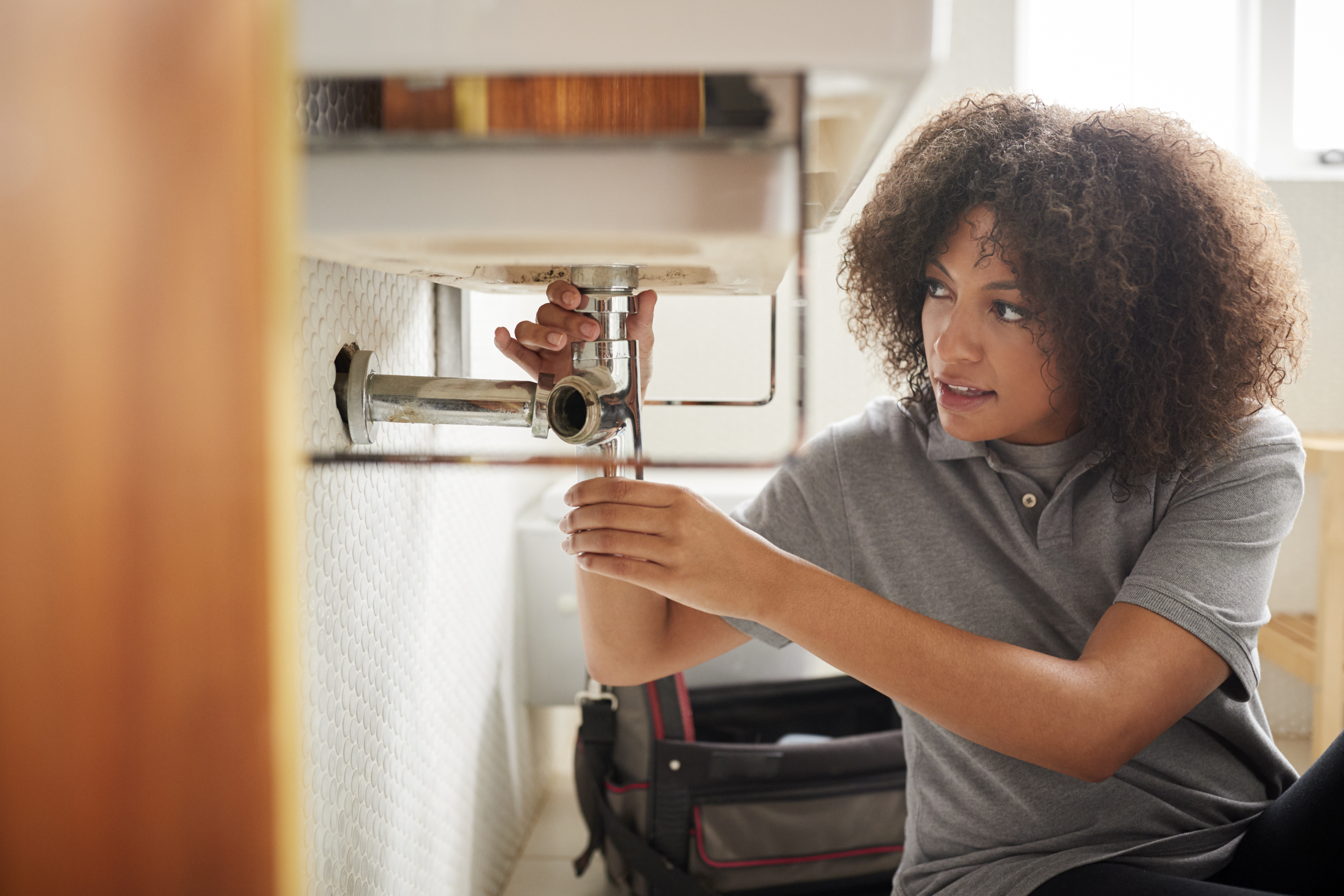
For decades, the skilled trades have been perceived as a male-dominated field. However, this landscape is rapidly changing. Not only are women welcome in the trades, but they are also actively encouraged to bring their unique talents and perspectives to a workforce hungry for skilled professionals. In 2021, 21% of women were considering trades as their career choice.
More...
Recent research has once again highlighted the overwhelming lack of female electricians currently in the UK electrical industry.
According to TradeSparky, out of over 250k British electricians, only around 2000 are female. This figure equates to a shocking 1% of the entire contingent of electricians in the UK.

A Man’s World?
The figures highlight the fact that the tradesperson industry is a male-dominated field and one that is severely lacking in female participation. Worse still, the pattern of a predominantly male workforce does nothing to spark female involvement and continues this trend further, as female uptake remains minimal.
However, the shocking stats don’t stop there. In addition to the inequality in gender employment, the imbalance also extends to the pay scale as well. Further to the incredible disparity between male and female participation figures, there is also a gender pay gap of just over £3.5k. Also according to TradeSparky, men receive an average annual wage of approximately £34.5 while women walk away with just under £31k.
Crossed Wires
Despite these male-skewed statistics, the tide is turning with each passing year with regards to equality in the workplace and the electrical trade does actually pose a great deal of opportunity for women looking to get into the manual trades profession.
In fact, when compared to average annual salary figures published by the Office of National Statistics, the average female electrician earns more than many other professions, such as legal associates (£29k), graphic designers (£27k), police community support officers (£27k), ambulance staff (£23k) and dental nurses (£18k).
What’s more, Direct Line for Business also revealed that 29% of UK adults would prefer to hire a woman to work on their home plumbing, if given the choice.
Become a Female Electrician with Access Training UK
If you’re interested in starting your career as a female electrician, Access Training UK can help get you where you want to be. We offer a variety of courses for all skill levels, and our courses are flexible and adaptable, allowing you to achieve your goals at your own pace.
Whether you’re a beginner that’s completely new to the sparky business, or are an existing professional looking to add a few extra strings to your bow, we have a course designed to suit you. Checkout the list down below for a full rundown of exactly what electrician courses we have available at Access Training UK.
New Career Courses
Perfect for those with little to no experience, our beginner courses include the following:
Trade Professional Courses
For the more seasoned professional, we offer the following courses, designed to expand your existing knowledge:
If you’d like to find out more information about how you can train to come a female electrician, or more detail about the different courses we offer, reach out and contact us today. A member of our first-class customer service team will be more than happy to run through the different courses we offer and help you find the right option for you.
Contact Us
Last updated 5th July 2022
Read More: Women in Plumbing: What Problems Do Female Plumbers Face?

How many women does it take to change a lightbulb?
One.
How many women does it take to install a state-of-the-art boiler system?
Still one, providing she’s had the appropriate training and gained the relevant qualifications.
Obviously.
The UK is currently undergoing a huge skills shortage, with too many jobs and too few workers (electricians, plumbers, carpenters, etc.) who are actually qualified to do them. This is putting a massive amount of pressure on the entire country; it’s something we hear about on the news, and it’s something we face when a pipe bursts and we actually have to find a plumber who can squeeze us into their busy schedule.
Britain is crying out for more people to learn these valuable skills. So why not women?
These industries have always been particularly male-dominated; when the words 'builder' and 'woman' are uttered in the same sentence, many people picture catcalls and wolf-whistles rather than a female bricklayer at work.
But why should this be case? Trade skills can lead to lucrative careers, and any determined, hardworking and intelligent person is more than capable of training up in one of these skills, regardless of their gender.
Lately, there has been an increase in the number of women entering these industries, hoping to benefit from all the same perks that tradesmen have been enjoying for years (e.g. good pay, rewarding work, choosing your own hours).
Gender equality within the trades won't change overnight - females currently make up just 6% of the workforce in certain trades, so it’s an uphill battle. However, the more women choose this path, the more women prove themselves just as capable as their male co-workers, and the more other women will feel encouraged to learn a trade themselves.
A fully-qualified woman is just as capable as a fully-qualified man, and therefore just as able to take advantage that this skills gap now provides.
Should women learn a trade?
If you enjoy working with your hands or don’t fancy a desk-based office job, then why not consider training up for a trade career and acquiring lifelong skills that will always be in demand? Being a woman should be no barrier, and there are lots of reasons why these industries make for desirable career paths, including:
- Great pay – experienced carpenters, electricians and plumbers can earn annual salaries of £30,000+.
- High demand – The current demand for people with these skills creates job stability as industries desperately try to fill vacancies.
- Be your own boss – Tradespeople often have the opportunity to become self-employed. This means you can pick your own jobs, hours and what you charge your clients.
- Less student debt – You don’t need a degree to learn a trade skill, and it no longer takes years to qualify. Training courses such as those available from Access Training Academies allow you to learn and get qualified quickly, so you can start earning as soon as possible.
How do I become qualified?
Training up to become a qualified tradesperson is much easier than it used to be. Traditionally, this career path would require years of studying in a college, with additional years working as an apprentice. Now training companies such as Access Training Academies allow you to study your chosen trade and learn the practical skills necessary on an intensive training course.
You can pick from several courses and several training centre locations across the UK to study your trade. We take a range of people all coming from diverse backgrounds - some just entering the world of work, some recently made redundant and looking to retrain, some just looking to carry out some DIY tasks around the home.
That’s why we understand that a training course can’t be a 'one size fits all' solution. We do everything we can to help you find a course that best suits your circumstances. It’s this flexibility that appeals to so many of our students - the ability to learn at your own pace while honouring family and work commitments. You can even start your training online!
Whether you want a complete change of career, some useful new skills, or an opportunity to top up the knowledge you already have, we're sure to have a suitable course for you. Access Training can take you from beginner to qualified worker, giving you all the skills necessary to get hired. If you aren’t ready to give up your current career, you can complete the course part-time and work while you learn.
Regardless of your age, sex, race or skill level, everyone on our courses is greeted with a warm welcome.
Call Access Training on 0800 345 7492 to discuss your goals with one of our friendly course advisors.
Browse Our Trade Courses >
Today - the 8th of March, 2016 - is
International Women's Day. This annual event began more than 100 years ago, and every March it serves as a great opportunity to celebrate the amazing achievements of women all over the world.
However, IWD is also an opportunity to highlight the many areas where gender equality still hasn't been achieved, and regrettably, our own field is a prime example. Female workers are still astoundingly rare in the construction and trade industries; according to
this article from last year, women account for just
11% of the UK construction industry's total workforce, and only
1% of
those women actually work on construction sites. Women are similarly under-represented in trades such as plumbing and electrical work, and while the ratios are beginning to shift, it's clear that there's still a long way to go.
So how can we encourage more people to learn a trade and join these male-dominated industries? First of all, people need to
change their attitudes towards tradeswomen, and that applies both to the general public and to representatives of the trades in question. A couple of years ago, the
Telegraph ran an article suggesting that roughly one-third of the UK population would be "suspicious" of a female electrician, and countless tradeswomen have shared their stories of the sexist remarks that come their way . Here's one example from Hattie Hassan, founder of
Stopcocks Women Plumbers (originally reported on
Sky News in 2014):
"Someone sent me an email saying, 'Look, love...plain and simple, women can't be plumbers. You'll break a fingernail and have to go out shopping to console yourself. Or you'll go running screaming when you see a spider.'"
Clearly, these sort of attitudes aren't helping anybody - it's easy to see why a budding female plumber or gas engineer might be put off. For this reason, we also need to do work harder to encourage women to join these trades in the first place, and that responsibility, at least to some extent, falls to training providers like us. The promotional materials distributed by construction/trade training centres are often targeted specifically at male learners, but this approach benefits nobody - after all, it's in the training provider's interest to attract as many new students as possible, regardless of gender.
Here at Access Training, we try to make people of all genders/races/backgrounds feel welcome at our training centres. We realise that we could still be doing more - for example, most of the photos currently on
our website are of men, not women. But the sad fact of the matter is that, right now, most of the people who enquire about our courses are male, and while we are keen to do whatever we can to get more women working in the trade and construction industries, it seems that this goal will be extremely difficult to achieve until people - namely the people who are "suspicious" of female electricians, the people who tell women they "can't be plumbers", and anyone else who continues to perpetuate the false notion that women aren't cut out for these jobs - adopt a more positive, welcoming attitude towards people who, at the end of the day, are just as capable of mastering these skills as any man.
Trade training courses from Access Training:
It seems our Tuesday blog post, entitled "Female Tradespeople on the Rise", was perfectly timed as yesterday Access Training received a visit from none other than Sky News. Working on a piece looking at the growth of females in trade careers such as plumbing, gas, carpentry, painting/decorating and more, Sky had a look around our centre before filming some of our woman trainees hard at work and then briefly interviewing them on their thoughts on women in the trade. Also interviewed as our very own carpentry tutor Gary, giving some of his thoughts on the differences he's seen between men and women working in the trade.
With women tradespeople now reportedly making up nearly 6% of the industry's overall workforce, the media are finally paying more attention to female tradespeople and why they are just as good (if not better) for the job as men are. The Sky News report won't just focus on women training here at Access, but also speak with women who have been working in the business for sometime.
Take a look below to see some of the photos we took from yesterday's filming:


The short piece is set to go out on Sky News sometime this weekend (we'll update you via Twitter and Facebook once it is confirmed) and will likely be shown repeatedly throughout the day. Be sure to watch out for us and if you're thinking of training towards a trade career - give us a call on 0800 345 7492! You'll then be able to get in contact with our course advice team, learn more about the courses we offer and even come visit our training facilities. As well as becoming a professional tradesperson quickly and effectively, who knows - maybe you'll end up on TV too!
Earlier this week the Guardian posted an article titled "The Rise of white van woman". Reading through it you'll see that, while perhaps not the best written article around, it does reveal one very important point - more and more women are now taking up trades such as plumbing, electrics, carpentry, bricklaying and more.
According to a study of 10,000 tradespeople across the UK from IronmongeryDirect (reported in Professional Builder magazine), women now represent 5.7% of all working tradespeople - dispelling notions by coming in higher than the proportion of migrant workers in the UK (4.6%). In the grand scheme of things this might still seem like a small figure, but is still a big leap forward that lead to further gender equality in the trades.
The Guardian's article also notes that between 2011 and 2012, B&Q reported a 400% increase in the number of women enrolling in its skills workshops. During this time Britain was also going through its economic recession, and so many women who were losing their jobs were going on to set up their own businesses. The appeal of a more physical and rewarding trade career has caught on, with more and more women starting their own businesses and groups/magazines such as Women In Trade. WIC Wales and Stopcocks forming to give support. The supposed gender barriers are breaking down at long last, and this is nothing but a good thing.
And it seems customers have no qualms with female tradespeople either, making the noticeable gender segregation in the trades even more outdated and antiquated. At Access Training we welcome female tradespeople just as we do male, which is why our doors are open to people of all ages, background and gender. These things should make no difference in a person's drive to become a qualified tradesperson, and this is reflected in the training we offer. Each week we see more and more female trainers come through our doors, all of which go on to have successful businesses in their respective trades. For example - Sarah Chandler from Cardiff was working as an administrator before she decided to change her career into something more practical. After completing both a plumbing and multi-skills construction course with us, she has now set up her own business, SLC Home Improvements, and is never short of work.
Are you looking to start a brand new career as a qualified tradesperson? Covering plumbing, electrics, gas engineering, carpentry, bricklaying, plastering, tiling and painting/decorating, Access Training offers a wide range of expertise taught under one roof by an experienced teaching staff. To find out more about our courses and to book your place, please give our advice team a call on 0800 345 7492.
New research conducted by Pink Plumbers, a national brand delivering female plumbers, has found that more women have the desire to become their own boss in the workplace then men.
The research, which was carried out last May, had a sample of 2000 adults from across the UK. It found that almost two out of three people (63%) wanted to take the steps toward self-employment. A total of 66% women wanted to be their own boss, narrowing out the males asked who came in at 60%.
Pink Plumbers was set up by single mother and entrepreneur Jo Lawrence, who created the franchise to make it easier for women wanting to join the plumbing trade by offering support and confidence. There is a clear gap in the market for female plumbers, with her research also noting that 86% of women think there should be more women working as plumbers. 69% of men also agreed.
Apart from setting up her Pink Plumbers franchise, Lawrence has also been proactive in organising a series of college roadshows across the UK, speaking to students about her own experiences as a plumber. She will also be publishing a book titled Hints and Tips for the Practical Plumber, which is due for release in September. It is designed to provide business and plumbing tips to help plumbers navigate through the difficulty of setting themselves up.
Encouraging trainee plumbers to take the steps to become self-employed is also something we encourage here at Access Training. As well as providing you with vital qualifications through our range of bespoke plumbing courses, our teaching staff will also guide you on how to set up your own plumbing business. If you would like to find out more about what Access can offer you, please contact us on 0800 345 7492.
Via HVP Magazine