According to new research commissioned by ADEY Professional Heating Solutions, installers and heating engineers might have a huge opportunity at their fingertips.

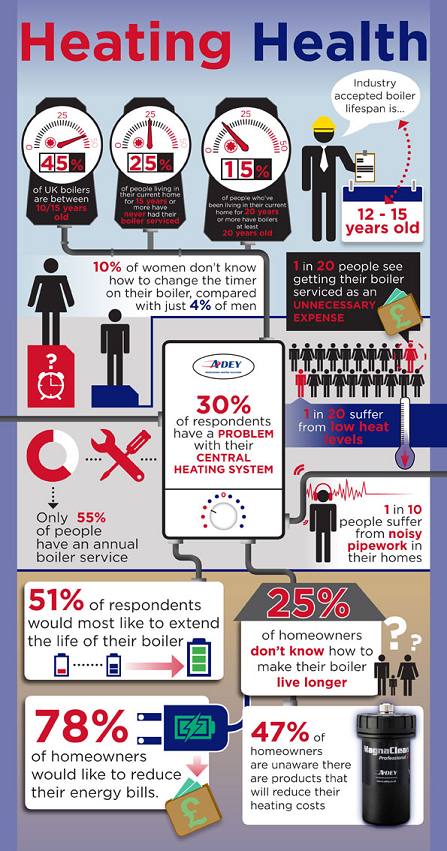
It seems that millions of homeowners across the UK are failing to maintain their central heating systems properly, resulting in not only a loss of efficiency but a reduced lifespan and an increase in the amount of energy needed to heat homes. Their research looked at more than 1300 homeowners across the UK, with only 55% of them confirming that they have their boiler serviced annually. One in 20 even said that they considered it an unneccesary expense!

ADEY also found that 45% of homeowners claim to have a boiler between 10 and 15 years old, with 25% who have lived in their current home for more than 15 years saying that they have never once had their boiler serviced. Furthermore, almost a third (30%) of homeowners have a problem with their central heating system, with one in 20 suffering from low heat levels. One in 10 people put up with noisy pipework in their homes – a common indicator of debris in the heating system – and 15% of people admitted they turn the thermostat up to try to fix their boiler, burning more fuel than necessary on a healthy heating system.

Consumer/environmental broadcaster Lucy Siegle said: "Boilers are the 'forgotten workhorses' of our homes. We expect them to carry on pumping away without any TLC, but homeowners need to understand that a well-maintained system costs less to run. This is where installers have a great opportunity to use their insider knowledge and help their customers counter rising energy bills by ensuring their heating systems work safely and efficiently."

ADEY’s commercial director Rebekah Howard added: "The results of our research suggest that many people don’t understand the benefits that having an annual boiler service will bring, and worryingly, just let their good old boiler in the corner keep chugging away without giving it any attention.

"The current climate presents installers with a timely opportunity to be telling customers how a well-maintained and efficient boiler can help save money on heating bills, reduce the risk of it breaking down when it’s cranked up to keep them warm, and ensure it’s safe to use. Installers can be assured that many of their customers will welcome this advice, as three quarters of homeowners surveyed wanted to know about the simple changes they can make to the central heating to reduce energy bills."

More findings from the search can be seen in the infographic below:

Via HVP Magazine

------

By becoming a qualified heating engineer, you too will be able to seize this opportunity for work. Not only that, but the life of a qualified plumber/engineer is varied, challenging and pays extremely well. You'll find yourself not only with a skill you'll have for the rest of your life, but a career that's never short of new work. But before any of this can happen, you'll need that right training and qualifications. Offering plumbing and gas engineer courses as both separate and combined packages, Access Training Academies is dedicated to helping students attain their goal of becoming professionally qualified, taking those first steps toward a brand new career. To find out more about how our courses can help you, contact one of our course advisers on 0800 345 7492 and book your place today!

As a former All Black and Cardiff Blues rugby team captain, 36-year old Xavier Rush is someone sports fans have probably heard of. But after a successful sporting career at both domestic and international levels he’s finally hanging his boots up and moving on to the next stage of his life. Choosing to retrain to become a fully-fledged property developer, he approached Access Training Academies and recently completed our kitchen fitting course. Now he’s moving on toward even more qualifications to expand his trade resume and take on even more work.

We sat down with his to discuss his plans for the future and how he’s finding the change from a ball to a toolkit...

Now that you’ve retired, what’s next for Xavier Rush?

Now that I’ve finished my rugby career I knew I obviously needed to retrain in something. I’ve always enjoyed properties and doing them up so I’ve come here to get as many strings to my bow as possible. The more I can do the less people I’d need to get in for jobs and the less I’d need to pay out.

I first did carpentry when I was 18 and had just left school, but it’s great to have a facility so close to me and the speed at which you can build your skills up. I originally came to do kitchen fitting which I’ve completed, but there’s the Part P electrical component to it too which I’m doing now for the next two and a half weeks. After that I plan to crack on and do six weeks of plumbing as well!

How has the course been so far?

I’ve been really enjoying it and the tutors have been excellent. There’s always some things that you’re better at than others – some of the bends in the plumbing took some time to get my head around. But the more practice you have the better you get at it. You aren’t going to sail through every day – some days are worse than others but you often find once you’ve slept on it, you come back the next day and get it. It’s great to be learning new skills and really refreshing to have a change of career. A lot of people get a bit scared but I’m really looking forward to it – it’s life after rugby for me.

Will you miss the rugby life?

Of course there’s always aspects you will miss – the getting up for a big game like a Heineken Cup match, playing in front of a big crowd. I’ll miss those moments but there’s enough of them in the memory bank to call on every now and then. It’s nice to be on the other side of it now and I’ve thoroughly enjoyed my career. I feel quite fortunate – it was a fairly long career and now I’m more excited about getting things started with my own business. It’s just time to move forward with life.

Look forward to more updates from Xavier Rush, who will be sharing his training experiences with us each week as he works towards his new qualifications. In the meantime if you have any questions you'd like to ask him about turning towards a brand new career, let us know on Twitter or Facebook and we'll pass the best ones onto him.

We could go on and on about why we feel Access Training is the best place to come for your trade qualifications, but our words don't mean anything unless the students we train can attest to the quality we aim to deliver. That's why we're going to start showcasing some of the positive feedback we've received about our range of intensive training courses, so that any of you reading that are on the fence can see that we really are dedicated to giving our candidates the best qualifications and practical trades training available. You can read more of the testimonials we've received in the past here.

After spending several years abroad, Mark Todd came home to kick start his new career on our Intensive Carpentry training course…

After leaving the Royal Marines around four years ago I got into working on maritime security on ships in East Africa. However after about 3 years I wanted to get a career back home, and I’ve always had an interest in carpentry. I’ve done a few little jobs here and there in the past but wanted to take it a bit further and get qualified.

I was originally going to go back to college but obviously that would have taken around two years to do. With Access Academies I’ve been able to come here and do the course in two months which has been so much better. I’ve come out of the course finishing on a Friday, then gone straight into a job the following Monday.

The eight weeks I’ve spent here have been excellent and I’ve really enjoyed my time. The tutors have been absolutely brilliant – I’ve learnt so much from them and they are always ready to give any advice you need. Not just with the work we do here, but if we’ve got anything else going on outside they’ll do the best they can to help which is really good of them to do off of their own backs. It really gets you raring to go – it got to the point in the last week where I just wanted to get out there and start working.

I’m about to start work with two carpenters doing some refurbishment in a nursing home. The work is ongoing, it’s local and I’ll be picking up experience from people who have been in the trade for 20 years each. Right now I still feel the need to carry on my learning. I plan to self-employed eventually but for the next six months to a year I’m just going to try and pick up as much experience as I can so I’ll be fully prepared.

- Mark Todd, Swansea

------

Have you considered stepping into a brand new career and becoming a fully qualified tradesperson? Here at Access Training Academies we offer a full spectrum of trade courses including plumbing, gas, electricity, carpentry, tiling, plastering and painting & decorating. By training with us not only will you enjoy our state-of-the-art facilities and experienced tutors, but also gain exactly what you need for a long and prosperous career. To find out more please get in contact with our course advisers on 0800 345 7492.

how much should i charge as an electrician

As an electrician you should charge enough to cover your costs and pay yourself - this is usually between £45 to $60 an hour. However, this price can change depending on a variety of factors. Read on to learn more about what you should be charging for your electrical work.

How Much Should You Charge as an Electrician?

So you've finished your electrical course and are ready to start your new life as a self-employed tradesperson. Being your own boss can mean great things like having full control over what jobs you do, what hours you work and when you can take your holidays - but there are some things you'll need to put some serious consideration toward. It's time for you to consider just how much you plan to charge for your services.

Ten Things to Consider When Deciding How Much to Charge as an Electrician.

how much should i charge as an electrician

Many people will work it out from a simple calculation of hourly rate multiplied by 35 hour week multiplied by 52. However how do you come up with a reasonable hourly rate in the first place? Check out 10 things you'll need to factor in to come up with the best price tag:

  1. Your Skill Level: More skilled electricians can take on specialist jobs, and therefore they can often charge more. Do you have a skill that requires a higher pay? Additionally, you may want to save money to go on a course to learn one of these specialist skills, like an electric vehicle charging installation course.
  2. Time off: When you are self-employed, you generally won't be paid for any time off. This includes sick days and annual leave. Learn to keep some money aside when you are working, to support yourself with when you can't.
  3. Insurance: Every business needs insurance. Not just that, but there's many different types you may need - public liability, business car insurance, contents insurances etc. Make sure you know exactly what you need and scout around for the best prices.
  4. Supplies: Don't forget that fuel and equipment is costly! If you're going to be buying supplies, you'll need to charge enough to cover those costs.
  5. Emergencies: As well as a regular supply budget, you'll need an emergency supply budget. Don't forget that vehciles can break down, and tools can stop working. You'll want to keep your tool-kit in top shape, so keep some money aside for if something breaks.
  6. Marketing: Do you want your own website? Business cards? Your phone number on the side of your van? Marketing is entriely up to you (unless you hire an agency) so it can cost as much or as little as you need. Just remember - marketing is crucial for bringing in new business. 
  7. Lost Business: Not every quote you give will result in a job, and these quotes can take a lot of time to put together. This is tricky though - you might not want to put your prices up just to account for lost quote time, as this could lead to even more lost business!
  8. Vehicle/space: Are you looking to stay as a one-person business forever, or do you have bigger dreams? If you want an office and a fleet someday, you might want to start saving for expanding your business from the get go
  9. Tax: If you don't want to keep track of you're own finances, then you'll need to hire an accountant or use an accounting service. This is an additional cost that not everyone considers at first, but as a self-employed person you are responsible for your own taxes, so this can be important!
  10. Getting Paid: This is the most important one! You will spend time and resources sending out invoices and chasing down payments. Take this time into consideration when billing.

Don't let this list stress you out too much. It might seem like a lot all together like this, but plenty of electricians manage all of the above and still take home a healthy sallary. This shouldn't disuade you from joining one of the most in-demand industries!

Does your initial estimate seem a little low? According to MyJobQuote, newly qualified electricians can £32,000 per year before tax.

-----------

Have you considered stepping into a brand new career and becoming a fully qualified tradesperson? Here at Access Training we offer a full spectrum of trade courses including electrical training. By training with us not only will you enjoy our state-of-the-art facilities and experienced tutors, but also gain exactly what you need for a long and prosperous career. To find out more please get in contact with our course advisers on 0800 345 7492 or click the button below.

 Electrical Courses

Full story: Daily Mail - 'Incompetent' plumber causes gas explosion

A 32-year old plumber is currently in court after he caused a gas explosion which resulted in a home being 'blown from its foundations' and leaving the couple inside with serious burns.

While converting the former kitchen of Martyn Moody and his wife Theresa's luxury home in the Lincolnshire Wolds into a dining room, plumber Daniel Hickling cut off and capped the protruding gas pipe, burying it under the floorboards. However during the work he punctured the pipe and failed to carry out a straightforward check to ensure there had been no damage to it.

Later the couple smelt gas and began searching their home. During this time Mr Moody flicked on a cigarette lighter and the flame ignited, causing a massive explosion with such force that the entire building moved an inch. Mr Moody, a retired construction and electrical tradesman spent two weeks in hospital undergoing skin grafts after suffering serious burns to his hands, arms and scalp. His wife suffered burns to her legs and feet but was released from hospital after two days.

The home, which the couple had built for themselves in 1993, sustained so much damaged that it had to be almost completely rebuilt. It was a year before the couple were able to move back in. They were also left £100,000 out of pocket after being found to be underinsured on their contents insurance and thus had to cover some of the loss themselves.

Lincoln Crown Court were told by prosecutor James Puzey that Hickley was "incompetent to carry out this work and it was carried out incompetently. That led directly to an explosion which almost destroyed the property and caused serious injury to the householders." It was also revealed that he was not a registered Gas Safe engineer and failed to tell the couple this when he agreed to do the work. However he claims that he did not know he would be working on a gas pipe and as such never put himself forward as properly qualified.

Hickley has admitted to breaching the 1998 Gas Safety Regulations and performing work to an inappropriate standard. Recorder Helen Malcolm QC has adjourned the case to a future date when she will give her ruling on the case following these two days of evidence.

-----

Cases like this are a prime example of why having the right qualifications to do the job is vital. Simply having plumbing qualifications is not enough if you are potentially going to work with gas pipes, as not only are you breaking the law and could potentially face prosecution but you are also endangering the lives of your customers. If you train as a gas engineer, becoming Gas Safe Registered isn't just advised, it is essential proof that you are legally competent to work with gas pipes and gas appliances safely. If you are a plumber and would like to learn more about gas engineering, gaining the qualifications required to be elligable for Gas Safe registration, we at Access Training offer comprehensive gas courses to ensure you are fully trained. To find out more click the link or give us a call on 0800 345 7492.

electric shower

Firstly when you’re having problems with your electric shower don’t attempt to fix it, this is false economy – you’re much better off changing the item completely. Here are a few steps to show you how to change an electric shower. 

  • Step One - Safely take off the front cover of the electric shower box. There will be at least 1 or possibly 2 small screws holding this in place. Next, take off the front temperature and control knobs by pulling them straight off (this shouldn’t be too difficult to do). With the front cover off you should be able to see a valve on the water pipe going into the shower unit, it should have a screw slot in the middle of the valve. Turn this a ¼ turn either way and test the shower to see if this has turned off the water. You can use the control knob by temporarily re-attaching it to the shower to get the water to flow.
  • Step Two - When changing an electric shower, you must turn off the electric supply at the consumer unit (or fuse board as it’s commonly known). The fuses/trips should be marked but if they’re not, the 1 of 2 possible trips you are going to turn off will be either a 35 amp or a 45 amp depending on the Kilo-watt power of the shower. For a 35 amp fuse/trip, the shower should not be over 8.5 kilowatts. For a shower that is greater in kilowatts, the fuse/trip will be a 45 amp.
  • Step Three - The next step in changing your electric shower is to check that the electric has been turned off by either pulling the cord switch in your bathroom or the wall-mounted one outside. Run the shower and make sure that the running water isn’t warm/hot. With the electric turned off, you can put a notice hanging from the consumer unit to warn others not to turn back on.
  • Step Four - If the water is now off you can take off the water connection where it connects closest to the unit. Undo the electric cable connections and remove the unit, remembering to replace like-for-like in the kilowatt power rating of the unit (this rating can be found somewhere on the old unit, and on the front cover box of the new one).
  • Step Five - When you have connected the new unit to the electric cable and to the water supply, check the water flow through the unit first, then with the cover on the unit you can turn the electric fuse/trip back on. Go back to the unit and turn the wall-mounted switch or pull the cord on, turn up the thermostatic control on the unit and the water control knob to on. Your new shower should be working, but with the new shower unit you will have the manufacturer’s instructions in the box. Follow these carefully, and it should be safe for you to install.

- Mark Lewis

 Would you like to learn more about the kind of DIY plumbing tasks you can perform yourself around the home? Access Training offers a number of bespoke plumbing courses for both DIY enthusiasts and those looking for a career as a professional plumber. You'll have access to our state-of-the-art training facilities and be taught by fully-trained plumbers with many years' experience in the trade. To find out more, give us a call on 0800 345 7492.

Following on from part 1 we will now look at what training courses are available to you, as well as factors such as their cost and duration.

At Access Training we deliver many construction courses, including;


Each course can vary from a one week taster course to a total of eight weeks, depending on the outcome you wish to achieve. The one week taster course will give you a good insight to your chosen trade, basic use of tools and basic techniques. Then there are two and three week courses which obviously involve a more in depth look at the particular trade. Each of these courses can give you a recognised qualification from City & Guilds.

The eight week course will give you a CAA Level 2 (Construction Awards Alliance) and potentially a NVQ diploma, both of which are again highly regarded and recognised C&G qualifications. The cost of each course varies, so I suggest you contact Access Training Wales and speak to one of the course advisors.

OK you’ve finished the course you’ve gained your qualification, what next? The truth is finding work is not as difficult as you may think. Most trainees after leaving Access Training start by doing small jobs for friends, family and neighbours.  This will build your confidence and give you some indication of how long a job will take. Best of all you will be under no pressure from family to complete by a certain deadline.

Then there are construction “agencies” that employ people to work on various jobs. They’ll find you the work, but be prepared to work maybe one week here, two weeks there and so on. This is a great way of gaining experience quickly and you will be on a fixed hourly rate, usually around £12 per hour.

So now that you’ve gained both experience and confidence, it’s time to go on your own. This is where you can earn a lot more money – it’s not uncommon for a good tradesperson to earn between £600-800 per week. Keep your options open, if you completed a bricklaying course don’t think that you can only lay bricks. Bricklayers can usually lay patios, decorative work indoors, build archways and more. If you completed a plastering course, plasterers can usually fix coving up, lay screed floors etc. One very lucrative area from a plastering point of view is “Venitian” or “Polished” plastering. There is a niche in the market for this type of work, if you have good trowel skills you can learn this method relatively quickly, and the price for doing this work is roughly £60 per square meter. So the choice is yours – there is work about for good tradespeople, so if you feel you need a career change then go for it!

If you need more information contact Access Training Wales on 08003457492.

- Richard James

Choosing to make a complete career change is difficult at any time of life. There are many factors to take into consideration – what opportunities are there? What training courses will I need to attend? How available is the work and how long will it last?

Take for instance many construction trades (bricklayer, carpenter, plasterer, tiler etc.). At this given time work is pretty slack in the construction industry, but I firmly believe that it won’t last much longer. So now is a good time to begin training for new skills. As soon as the construction industry opens its doors again, there will be a definite skills shortage. Having decided to take the challenge and change career what can you expect to be doing on a daily basis?

Take the plastering trade as an example, which provides plenty of opportunity to work both inside or outside. The weather in this country is not the best, so having the chance to work indoors is an added bonus; you will be working most days and won’t be losing money. Plastering covers more than just “plastering” a wall, it could be screeding a floor, plaster boarding a ceiling, dot & dab on walls, dry lining a wall, the list goes on. This is all internal work, whereas dashing, fine down, K render are all external.

Are there any transferable skills you could use, depending on your background? Plastering involves calculating quantities for mixes etc. so numeracy skills would be an advantage. A lot of questions are asked in the workplace so good communication skills would help, the ability to work unsupervised is a great asset to have, as a lot of the time you are given work and be expected to carry it out unsupervised to a high standard.

So having trained for your new career, what qualifications do you need for the construction industry? An NVQ in a relevant trade is essential; this will allow you to apply for a CSCS card – a must have to work on building sites.

Tomorrow in part 2 I will discuss what training courses are available to you, as well as their cost, duration and what you can expect to learn. Also included will be what prospects are open to you and potential wages upon completion.

- Richard James

When hiring a plumber or any other tradesperson, there are a number of things you should find out beforehand. Questions such as what kind of plumbing training they've had, their qualifications and previous experience are crucial when it comes to getting the best value for money.

The first and foremost way to find a reputable tradesman is to ask friends, family or other tradespeople for a recommendation. Others who can recommend a tradesperson have had the experience of what he/she is capable of, how much they charge for certain works, how reliable they are and most importantly how good their work is.

Failing this, there are schemes where tradespeople register with known as competent person schemes. Any tradesperson who has joined such a scheme is prepared to have his work regularly checked by such people as Building Control officers from the local council, water authorities and competent person scheme inspectors. These control the quality of the tradesperson's work, and can be trusted.

Unfortunately there is nothing to stop cowboy tradespeople setting up and trading. Only when they have ripped off a number of people who have subsequently complained to Trading Standards will there be an investigation into the quality of work and the prices they charge.

But if you have employed such a tradesperson who has not done an acceptable level of work to your property, then you have the right to call them back regardless of the price you paid them. The attitude of "you didn't pay a lot so what do you expect" is not an excuse for poor quality of work. As a tradesperson who has been in this industry for over 30 years, the price you pay for a job should not reflect the quality, and any tradesperson with a good work ethic towards their customers will not overcharge and do the job to the standard required. Their customers will feel they have had value for money and won't have to call the tradesperson back for a fault on their work.

- Mark Lewis


Are you looking to change careers and become a professionally qualified plumber yourself? Access Training Wales offer a number of accredited plumbing courses, not just for those looking to start a new career but also for DIY enthusiasts wanting to earn some new skills. For more information on what courses are available to you give us a call on 0800 345 7492.

Get in touch to learn more about our training courses!

First Name *
Surname *
Telephone Number *
E-mail address *
Ask A Question *
 
Security Character Security Character Security Character Security Character Security Character Security Character
Enter Letters (No Spaces) *