It wouldn't be right to support Gas Safety Week without taking some time to talk about who set up the campaign - The Gas Safe Register. If you've been reading our posts you'll already know that joining the Gas Safe Register is a legal requirement of all gas engineers if they want to work on gas installations and appliances in the UK, but what else do you know about them?

The Gas Safe Register is the official gas registration body for the United Kingdom, Isle of Man and Guernsey and was appointed by the relevant Health and Safety Authority for each area. It replaced CORGI as the gas registration body in Great Britain and Isle of Man on the 1st April 2009 and Northern Ireland and Guernsey on the same date the following year.

The main focus of the Gas Safe Register is improving and maintaining gas safety to the highest standards, however its utmost priority is keeping you and your family safe. Their team make sure all gas engineers on the Register (totalling over 125,000) are fully qualified to work with gas. It works to protect the public from unsafe gas work through a number of different means, including;

  • A dedicated national investigations team tracking down individuals working illegally
  • Regular inspections of Gas Safe registered engineers
  • Educating consumers and raising awareness of gas safety
  • Investigating reports of unsafe gas work 

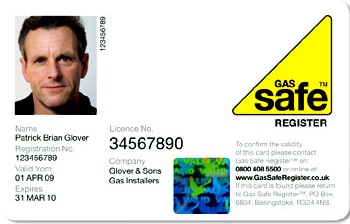
The Gas Safe Register highly advise that you always find an engineer that is part of the register. You can check this by asking to see their Gas Safe ID card, which will contain a unique license number. The front of the card will also display these important details:

  • The engineer's photo
  • The start and expiry dates
  • A security hologram
  • That engineer is from the business you employed

Meanwhile, the back of the card will also have printed on it whether that engineer is qualified to do the work you've hired him for and whether these qualifications are up to date. Should that fail, you can also check online or phone the Register on 0800 408 5500. This number is also the one to call if you suspect a fraudulent gas engineer.

How do I apply for a Gas Safe ID card?

First, you need to submit the name, address, phone number and trading title of your business to the Gas Safe Register. Then, you'll need to provide your National Insurance number and the National Insurance numbers of any engineers working for you. Once you've paid for your Gas Safe Id card, and the necessary checks have been done, it will be sent out to you.

What are the Gas Safe ID card categories?

Depending on what level of qualification you have, your Gas Safe Id card will show one of two categories, domestic or commercial work. This indicates the type of work that you're qualified to do. If you've got a gas engineer attending your property, but you're not sure if they're qualified for the domestic or commercial work at hand, you can ask to see their Gas Safe ID card to check this.

Can the gas safe register review gas work?

If you feel that gas work carried out at your home is unsafe, you can raise your concerns with the Gas Safe Register directly. They will record the problem and can even arrange an investigation of the problem. Once the investigation has been done, a report can be sent to you and your gas engineer so that any problems can be dealt with appropriately.

If you're unsure how to find a Gas Safe Registered engineer in your area, you can also contact the Gas Safe Register for their recommendations. They can highlight gas engineers and professionals in your local area that may be able to carry out a service for you.

So there you have it, a little bit more about the Gas Safe Register and what it does. If you need gas work done always be sure to check your engineer is registered, and if you're a register remember that being part of it is a legal requirement!

To mark Gas Safety Week, Access Training are offering 20% off our professional gas course from now until the end of September. To take advantage of this offer all you need to do is quote "GASWEEK" when speaking to one of our course advisors. You can contact them on 0800 345 7492.

An important part of Gas Safety Week is making sure people know exactly what to do in the event of a gas leak.

Every year thousands of people across the UK are diagnosed with carbon monoxide poisoning. This highly poisonous gas can't be seen, smelled or tasted, but can kill quickly and without warning. Early symptoms of carbon monoxide poisoning include headaches, dizziness, nausea, breathlessness and then eventually collapsing and even loss of consciousness. As an invisible gas, carbon monoxide can be extremely difficult to detect. However there are ways that you can determine whether an appliance (such as fires, heating boilers, water heaters or cookers) are dangerous. These include:

  • The pilot light continually blowing out
  • An orange or yellow flame rather than a blue one
  • A discoloured scorched area on an appliance
  • A musty smell or signs of soot
  • More condensation than normal on windows

If you see any of these things, whatever you do DO NOT try to attempt any sort of repair work yourself - you could only end up making it worse. Instead what you should do is call the free emergency gas number on 0800 111 999 and follow their instructions. As soon as you suspect a leak, don't start any flames or operate electrical switches. Make sure to put out any fires, open doors and windows to air out the rooms, keep people away from the area and turn the gas off at the control valve. 

Once you've made the call, a trained operator will log a number of details onto a computer. The kind of questions they'll ask you are:

  • Your name and phone number
  • The address and postcode of the suspected gas emergency 
  • How many people are at the property 
  • Where the smell is most noticeable 
  • How long the smell has been noticeable
  • Are any neighbours affected 
  • Any special circumstances or access information
Following that you'll be asked a number of questions to determine the severity of the situation. This information will be recorded and sent off to an engineer to take action if its required.

Following our plumbing glossary yesterday, Access Training have also put together a brief post covering common electrical terms that will be handy for all the aspiring electricians out there - whether they're DIY enthusiasts or aiming for a professional career.

Bonding: The process by which all metal parts in a circuit are electrically connected together and then linked to a real earth. This is done to prevent any metal component within a building becoming dangerous should it become live due to an electrical fault or damage. Any fault should cause the circuit protection device to operate and isolate the incoming mains.

BS 7671: Currently in its 17th Edition, this is the UK national safety standard for electrical installation work.

Consumer Unit: These are used to control and distribute electricity around the home. They usually contain a mains switch, fuses/circuit breakers and one or more residual current devices.

Earthing: In the event that there is a fault in the circuit, this will minimise the risk of an electric shock. It provides a path for the faulty current to flow safely to earth, causing the protective device (such as a fuse) to disconnect the circuit and stop the danger. An electrician should check that the earthing and bonding is satisfactory before starting any work.

Electrical Installation Condition Report (EICR): A report on the condition of your electrical wiring, containing an overall assessment of the safety of the wiring, observations on its condition, and a number of recommendations (in order of priority) for action (if any is required) to restore the wiring to a satisfactory condition for continued safe use. These were formerly known as Periodic Inspection Reports (PIRs).

Flush-fitted: These are electrical switched or sockets that have been installed so that their back boxes are contained within the wall or ceiling, making only the front plates visible. This often looks nicer than surface mounted connections but usually requires chasing to complete.

Miniature Circuit Breaker (MCB): These are automatic protective devices fitted into fuse boxes. They will disconnect a circuit should there be a fault or overload.

Part P: The specific section of the Building Regulations for England and Wales, which relates to electrical installations in domestic properties.

Surface-mounted: This is when switches and sockets are installed on top of a surface rather than behind it. While it is less seamless than flush-fitted installations, it causes less disruption to any decoration that surface may have.

Two Way Switch:  Switches which can be used in pairs so that either can turn a light on or off. Each switch has terminals allowing them to be linked using Three Core and Earth cable.

Of course once again this is only a very brief look at some of the things electricians come across on a daily basis, and is no substitute for proper comprehensive electrical training. If you would like to find out more about what it takes to become an electrician, earn valuable skills and the qualifications to go professional - Access Training have exactly what you need. With courses suitable for both trainees and homeowners looking to do a spot of DIY on their property, now has never been a better time to gain a better understanding of the electrical trade. Please visit the courses section of our website or alternatively get in touch with our team on 0800 345 7492.

While good practical training may be the most vital quality to have in a plumber, it's important that they also have a good grasp of the common terminology they may come across while on the job. So, Access Training have put together a very basic glossary of various plumbing terminology, which will hopefully be of benefit to some of you.

Actual capacity: The amount of water contained in a cistern or other container when it is full to its practical working level.

Air-lock: Air trapped in pipes, causing a reduction or complete stop in the flow of liquid.

Back-siphon: A condition where the flow of liquid is reversed and siphons back towards the source, which can lead to contamination.

Bar: The unit that water pressure is measured in.

Bleed valve: A valve that releases air from the central heating system.

Cistern: A contained used for holding water at atmospheric pressure.

Flow rate: The volume of water that is delivered to a tap, recorded in litres per minute (l/m) or litres per second (l/s).

Grey water: Waste water from domestic processes.

Hard water: Water which contains a higher level of calcium salts, making it an alkaline. When heated it deposits the salts on various components in a system, causing "furring up".

Main water valve: The main water shutoff that prevents any water from going into any of the pipes or plumbing. Plumbers may refer to it as the main shutoff valve.

Nominal capacity: The amount of water contained in a cistern or other container when it is full to the top edge.

Soft water: Rain water that falls on peaty, moorland and sandstone areas and is acidic. Soft water is better for washing, but can lead to many corrosion problems.

Stopcock: A hand operated on/off valve permitting water flow in one direction. The house stopcock is located where the supply enters the property, and can be used to shutoff water to all fixtures in the house.

Storage cistern: A specific type of cistern used for storing water to be used, such as delivering hot and cold water through pipework.

Supply pipe: A pipe that carries mains cold water around the home.

Tank: A container that is not open to atmosphere, usually a non-cylindrical closed vessel.

Vent pipe: Pipe that allows the release of air or water from a hot water system.

Of course this is only a very brief glossary, and missing many of the things you'll need to know as a professional plumber. If you would like to learn more and perhaps even gain the qualifications needed to become a plumber, an Access Training plumbing course could be exactly what you're looking for. To find out more please visit the courses section of our website or give us a call on 0800 345 7492.

New research conducted by Pink Plumbers, a national brand delivering female plumbers, has found that more women have the desire to become their own boss in the workplace then men.

The research, which was carried out last May, had a sample of 2000 adults from across the UK. It found that almost two out of three people (63%) wanted to take the steps toward self-employment. A total of 66% women wanted to be their own boss, narrowing out the males asked who came in at 60%.

Pink Plumbers was set up by single mother and entrepreneur Jo Lawrence, who created the franchise to make it easier for women wanting to join the plumbing trade by offering support and confidence. There is a clear gap in the market for female plumbers, with her research also noting that 86% of women think there should be more women working as plumbers. 69% of men also agreed.

Apart from setting up her Pink Plumbers franchise, Lawrence has also been proactive in organising a series of college roadshows across the UK, speaking to students about her own experiences as a plumber. She will also be publishing a book titled Hints and Tips for the Practical Plumber, which is due for release in September. It is designed to provide business and plumbing tips to help plumbers navigate through the difficulty of setting themselves up. 

Encouraging trainee plumbers to take the steps to become self-employed is also something we encourage here at Access Training. As well as providing you with vital qualifications through our range of bespoke plumbing courses, our teaching staff will also guide you on how to set up your own plumbing business. If you would like to find out more about what Access can offer you, please contact us on 0800 345 7492.

Via HVP Magazine

Installing a tap will only take you around half a day, but you will need basic plumbing skills. Under current regulations you have to fit an isolation valve and a double check valve inside your home when you put in a new outdoor tap (see below for details). If you need to know more about the regulations talk to your Water Company or local council.

  1. Turn the isolation valve off if there is one on your cold water supply pipe where your new garden tap is to be connected.

  2. If there's no isolation valve, turn off your main stopcock. This is fitted on the pipework and normally found either in the kitchen or where the mains water enters your house.

  3. Finally if you can't find the stopcock, turn off the water authority's valve under the cover in the street or your front garden. You'll need a special long-handled spanner, available from plumbers' merchants. Once the water supply is off, open the cold tap on your sink until the water stops running and the system is drained.

  4. If you're installing a new tap you need to bore a hole through your outside wall for the connecting pipework. It's easiest to make the new connection near an exposed cold water supply inside your house - near the kitchen sink, for example.

  5. Position your outdoor tap at least 250mm above the damp-proof course. Then mark the screw holes where your tap will be.

  6. You will need a 15mm diameter pipe to connect the tap to the cold water supply inside the house. Position the hole for this about 150mm above where you've marked the position of the tap.

  7. Before drilling the hole, run the pipe through a piece of 22mm diameter copper pipe. This acts as a 'sleeve', which will prevent the pipe rubbing and water leaking out of the hole if the pipe bursts. When drilling, make sure the hole is wide enough to take the sleeve's diameter.

  8. Steadily drill through the wall with a heavy-duty power drill and a large masonry bit at least 325mm long. Take out the core bit regularly to clear the loosened masonry and let the bit cool down.

  9. With the supply turned off, cut through the cold water pipe directly below the exit hole you've drilled in the wall. Use a hacksaw or pipe slicer to do this and file the ends of the pipes smooth.

  10. Remove enough pipe to fit a T-piece connector. Connect one end of a short piece of pipe to the T-piece. Connect the other end to an isolation valve. This allows you to cut off the water supply to the new tap if you need to in the future. Isolation valves let you turn off the water to an individual appliance without having to turn off the whole water supply. You can get two types of isolation valve: a push-fit valve, which simply pushes on to the ends of the pipes, and a compression valve.

  11. Fit the valve the right way round or else it won't work correctly – there will be an arrow on the valve showing the direction of the flow of water.

  12. When you've turned off the water supply, mark the section of pipe that needs removing to receive the valve. Cut the section from the pipe and be sure to file the ends smooth again.

  13. Now slide a compression nut onto each piece of pipe followed by the olives. Push each end of the pipe into the fitting and tighten the compression nuts by hand.

  14. Use a pair of pliers to hold the body of the valve and tighten the compression nuts about three-quarters of a turn with an adjustable spanner. When you turn on the water supply again, check for leaks. Tighten the compression nuts a little further if you have to.

  15. Next you'll need another short piece of pipe to connect the isolation valve to a double check valve. Water regulations say you must fit one of these to your outside tap pipework. Double check valves stop water flowing back up a pipe the wrong way. This prevents contaminated water entering your drinking water supply.

  16. For a new outside tap the double check valve must be fitted in your internal pipework, after the isolation valve. Double check valves are installed in a similar way to isolation valves.

  17. After fitting the double check valve insert another short piece of pipe and an elbow. Then fit a length of pipe long enough to reach horizontally through the wall to the outside. When it's through the wall, cut the pipe to leave about 25mm protruding.

  18. Finally, you'll need to cut a piece of pipe that reaches from the pipe protruding from your outside wall down to the position of your tap. These pipes will be connected using another elbow joint.

  19. Connect all the parts together and tighten the joints with two adjustable spanners. You can tighten the joints more if they leak when the water supply is turned back on, but be sure not to over tighten.

  20. Drill the fixing holes for the tap's wall plate, insert plugs and screw the tap plate to the wall. Screw the tap tail into the elbow joint.

  21. Use plastic retaining clips for the pipes on the inside wall to stop the pipes vibrating and knocking against it. Then seal around the pipe hole in the wall with an expanding foam filler or sealant.

  22. Water resistant foam pipe lagging should cover all the pipework that is on the outside of the building to protect against freezing. This will be fitted after testing for leaks.

  23. Finally, turn the water supply back on and check for any leaks. Tighten joints if you need to and then you're ready to go!

- Mark Lewis


While we hope that this quick guide has helped you in installing your very own outside tap, there is only so much that can be explained online. If you would like to learn more plumbing skills, whether it be for future DIY projects or to attain the qualifications to become a professional plumber, we offer a number of intensive plumbing courses here at Access Training. If you would like to find out more, contact us on 0800 345 7492.

Full story: Daily Mail - 'Incompetent' plumber causes gas explosion

A 32-year old plumber is currently in court after he caused a gas explosion which resulted in a home being 'blown from its foundations' and leaving the couple inside with serious burns.

While converting the former kitchen of Martyn Moody and his wife Theresa's luxury home in the Lincolnshire Wolds into a dining room, plumber Daniel Hickling cut off and capped the protruding gas pipe, burying it under the floorboards. However during the work he punctured the pipe and failed to carry out a straightforward check to ensure there had been no damage to it.

Later the couple smelt gas and began searching their home. During this time Mr Moody flicked on a cigarette lighter and the flame ignited, causing a massive explosion with such force that the entire building moved an inch. Mr Moody, a retired construction and electrical tradesman spent two weeks in hospital undergoing skin grafts after suffering serious burns to his hands, arms and scalp. His wife suffered burns to her legs and feet but was released from hospital after two days.

The home, which the couple had built for themselves in 1993, sustained so much damaged that it had to be almost completely rebuilt. It was a year before the couple were able to move back in. They were also left £100,000 out of pocket after being found to be underinsured on their contents insurance and thus had to cover some of the loss themselves.

Lincoln Crown Court were told by prosecutor James Puzey that Hickley was "incompetent to carry out this work and it was carried out incompetently. That led directly to an explosion which almost destroyed the property and caused serious injury to the householders." It was also revealed that he was not a registered Gas Safe engineer and failed to tell the couple this when he agreed to do the work. However he claims that he did not know he would be working on a gas pipe and as such never put himself forward as properly qualified.

Hickley has admitted to breaching the 1998 Gas Safety Regulations and performing work to an inappropriate standard. Recorder Helen Malcolm QC has adjourned the case to a future date when she will give her ruling on the case following these two days of evidence.

-----

Cases like this are a prime example of why having the right qualifications to do the job is vital. Simply having plumbing qualifications is not enough if you are potentially going to work with gas pipes, as not only are you breaking the law and could potentially face prosecution but you are also endangering the lives of your customers. If you train as a gas engineer, becoming Gas Safe Registered isn't just advised, it is essential proof that you are legally competent to work with gas pipes and gas appliances safely. If you are a plumber and would like to learn more about gas engineering, gaining the qualifications required to be elligable for Gas Safe registration, we at Access Training offer comprehensive gas courses to ensure you are fully trained. To find out more click the link or give us a call on 0800 345 7492.

Choosing to make a complete career change is difficult at any time of life. There are many factors to take into consideration – what opportunities are there? What training courses will I need to attend? How available is the work and how long will it last?

Take for instance many construction trades (bricklayer, carpenter, plasterer, tiler etc.). At this given time work is pretty slack in the construction industry, but I firmly believe that it won’t last much longer. So now is a good time to begin training for new skills. As soon as the construction industry opens its doors again, there will be a definite skills shortage. Having decided to take the challenge and change career what can you expect to be doing on a daily basis?

Take the plastering trade as an example, which provides plenty of opportunity to work both inside or outside. The weather in this country is not the best, so having the chance to work indoors is an added bonus; you will be working most days and won’t be losing money. Plastering covers more than just “plastering” a wall, it could be screeding a floor, plaster boarding a ceiling, dot & dab on walls, dry lining a wall, the list goes on. This is all internal work, whereas dashing, fine down, K render are all external.

Are there any transferable skills you could use, depending on your background? Plastering involves calculating quantities for mixes etc. so numeracy skills would be an advantage. A lot of questions are asked in the workplace so good communication skills would help, the ability to work unsupervised is a great asset to have, as a lot of the time you are given work and be expected to carry it out unsupervised to a high standard.

So having trained for your new career, what qualifications do you need for the construction industry? An NVQ in a relevant trade is essential; this will allow you to apply for a CSCS card – a must have to work on building sites.

Tomorrow in part 2 I will discuss what training courses are available to you, as well as their cost, duration and what you can expect to learn. Also included will be what prospects are open to you and potential wages upon completion.

- Richard James

Not all electrical work requires a trained professional. Minor tasks such as replacing a light switch can be performed without having to notify your Local Authority Building Control Department, however they still must be done to current Building and Electrical regulation standard.

While there are a wide variety of different types of light switch you might find in the home (including pull-cord switches, narrow architrave switches and rotary dimmers), here is a guide to the most basic of them – the one-way and two-way switch. The difference between them is that two-way switches are used where there is more than one switch connected to the same light (e.g. at the top and bottom of the stairs).


Safety first

Before you start ANY sort of electrical work make sure the power is switched off at the main consumer unit OR switch off the relevant circuit breaker and lock it if you can. Then make sure that the circuit is indeed dead using a voltage tester/meter. Also take note that since 2006 the core colours inside electrical cables have changed. In the new two-core-and-earth cable, the live or phase core is insulated in a brown sheath rather than red. The neutral core is now blue as opposed to black.


What you will need:

  • Voltage tester/meter
  • Side cutters Screwdrivers
  • Green/yellow earth sleeving
  • Suitable replacement plateswitch (1 or 2-way)
  • Screws
  • Brown PVC electrical tape or sleeving
 

For one-way switches:

Step 1: Isolate the circuit and then confirm that the power is off using your voltage tester. Unscrew the switch faceplate and pull it forward, revealing the connections behind. These terminals will usually be marked something like L1, L2 and COM.

Step 2: Draw a diagram so that you remember which colour and number of wires were attached to each terminal. Then release the terminal screws and pull the cores from them. If the earth core is properly insulated in green/yellow sleeving and connected to the mounting box, leave this attached.

Step 3: Connect these cores to the correct terminals of the new switch, using your diagram as a reference. Tighten the screws and check they are clamping the cable cores firmly by gently tugging the wires.

Step 4: If there isn’t one already, fit a length of brown sleeving over the blue core to indicate that it is a switched live.

Step 5: If it’s not already fitted, put some green/yellow sleeving over the bare earth core of the incoming cable and connect it to the earthing terminal of the mounting box. If you’re using a metal switch, be sure to earth the switch faceplate as well.

Step 6: Double check that each connection is secure, then push the cable back into the mounting box and fit the faceplate.


For two-way switches:

While this is similar to a one-way switch there will normally be three cores to the cables – coloured brown (formally red), black (yellow) and grey (blue). Again these terminals will be labelled something like L1-3 and COM.

Step 1: Isolate the circuit and make sure the power is off with your voltage tester.

Step 2: Remove the faceplate from the existing switch and disconnect the cable cores.

Step 3: Note which colour goes to which terminal (write it down if you think you’ll forget!) and then transfer them to the corresponding terminals on the new switch.


While this is simply a brief guide to some of the electrical work you can do yourself around the home, more technical electrical work will require you to have a Part P qualification if you wish to carry it out yourself. If you are interested in learning about more work you can do or achieving Part P qualification then the best way is to learn from one of Access Training’s comprehensive electrical training courses. Offering professional qualifications to both aspiring and existing electricians as well as DIY courses, there truly is something for everyone regardless of age, gender, background or experience.

Contact Access Training on 0800 345 7492 for more information or to arrange a visit of our training facilities.

Get in touch to learn more about our training courses!

First Name *
Surname *
Telephone Number *
E-mail address *
Ask A Question *
 
Security Character Security Character Security Character Security Character Security Character Security Character
Enter Letters (No Spaces) *