
According to new research commissioned by ADEY Professional Heating Solutions, installers and heating engineers might have a huge opportunity at their fingertips.

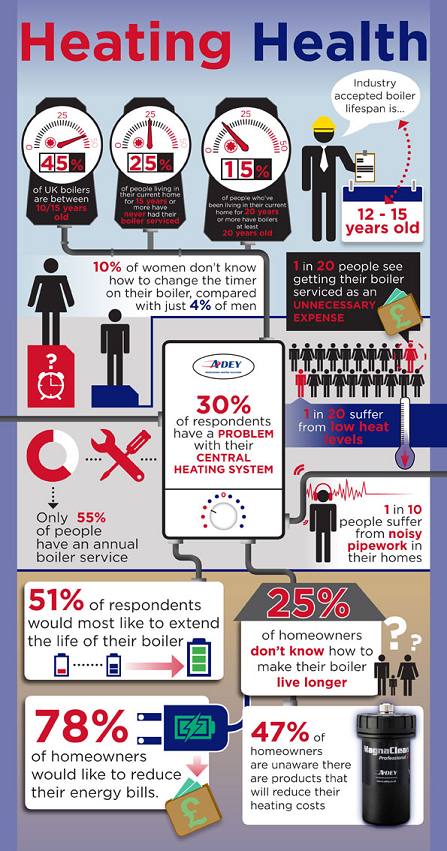
It seems that millions of homeowners across the UK are failing to maintain their central heating systems properly, resulting in not only a loss of efficiency but a reduced lifespan and an increase in the amount of energy needed to heat homes. Their research looked at more than 1300 homeowners across the UK, with only 55% of them confirming that they have their boiler serviced annually. One in 20 even said that they considered it an unneccesary expense!

ADEY also found that 45% of homeowners claim to have a boiler between 10 and 15 years old, with 25% who have lived in their current home for more than 15 years saying that they have never once had their boiler serviced. Furthermore, almost a third (30%) of homeowners have a problem with their central heating system, with one in 20 suffering from low heat levels. One in 10 people put up with noisy pipework in their homes – a common indicator of debris in the heating system – and 15% of people admitted they turn the thermostat up to try to fix their boiler, burning more fuel than necessary on a healthy heating system.

Consumer/environmental broadcaster Lucy Siegle said: "Boilers are the 'forgotten workhorses' of our homes. We expect them to carry on pumping away without any TLC, but homeowners need to understand that a well-maintained system costs less to run. This is where installers have a great opportunity to use their insider knowledge and help their customers counter rising energy bills by ensuring their heating systems work safely and efficiently."

ADEY’s commercial director Rebekah Howard added: "The results of our research suggest that many people don’t understand the benefits that having an annual boiler service will bring, and worryingly, just let their good old boiler in the corner keep chugging away without giving it any attention.

"The current climate presents installers with a timely opportunity to be telling customers how a well-maintained and efficient boiler can help save money on heating bills, reduce the risk of it breaking down when it’s cranked up to keep them warm, and ensure it’s safe to use. Installers can be assured that many of their customers will welcome this advice, as three quarters of homeowners surveyed wanted to know about the simple changes they can make to the central heating to reduce energy bills."

More findings from the search can be seen in the infographic below:

Via HVP Magazine

------

By becoming a qualified heating engineer, you too will be able to seize this opportunity for work. Not only that, but the life of a qualified plumber/engineer is varied, challenging and pays extremely well. You'll find yourself not only with a skill you'll have for the rest of your life, but a career that's never short of new work. But before any of this can happen, you'll need that right training and qualifications. Offering plumbing and gas engineer courses as both separate and combined packages, Access Training Academies is dedicated to helping students attain their goal of becoming professionally qualified, taking those first steps toward a brand new career. To find out more about how our courses can help you, contact one of our course advisers on 0800 345 7492 and book your place today!

We could go on and on about why we feel Access Training is the best place to come for your trade qualifications, but our words don't mean anything unless the students we train can attest to the quality we aim to deliver. That's why we're going to start showcasing some of the positive feedback we've received about our range of intensive training courses, so that any of you reading that are on the fence can see that we really are dedicated to giving our candidates the best qualifications and practical trades training available. You can read more of the testimonials we've received in the past here.

After spending several years abroad, Mark Todd came home to kick start his new career on our Intensive Carpentry training course…

After leaving the Royal Marines around four years ago I got into working on maritime security on ships in East Africa. However after about 3 years I wanted to get a career back home, and I’ve always had an interest in carpentry. I’ve done a few little jobs here and there in the past but wanted to take it a bit further and get qualified.

I was originally going to go back to college but obviously that would have taken around two years to do. With Access Academies I’ve been able to come here and do the course in two months which has been so much better. I’ve come out of the course finishing on a Friday, then gone straight into a job the following Monday.

The eight weeks I’ve spent here have been excellent and I’ve really enjoyed my time. The tutors have been absolutely brilliant – I’ve learnt so much from them and they are always ready to give any advice you need. Not just with the work we do here, but if we’ve got anything else going on outside they’ll do the best they can to help which is really good of them to do off of their own backs. It really gets you raring to go – it got to the point in the last week where I just wanted to get out there and start working.

I’m about to start work with two carpenters doing some refurbishment in a nursing home. The work is ongoing, it’s local and I’ll be picking up experience from people who have been in the trade for 20 years each. Right now I still feel the need to carry on my learning. I plan to self-employed eventually but for the next six months to a year I’m just going to try and pick up as much experience as I can so I’ll be fully prepared.

- Mark Todd, Swansea

------

Have you considered stepping into a brand new career and becoming a fully qualified tradesperson? Here at Access Training Academies we offer a full spectrum of trade courses including plumbing, gas, electricity, carpentry, tiling, plastering and painting & decorating. By training with us not only will you enjoy our state-of-the-art facilities and experienced tutors, but also gain exactly what you need for a long and prosperous career. To find out more please get in contact with our course advisers on 0800 345 7492.

how much should i charge as an electrician

As an electrician you should charge enough to cover your costs and pay yourself - this is usually between £45 to $60 an hour. However, this price can change depending on a variety of factors. Read on to learn more about what you should be charging for your electrical work.

How Much Should You Charge as an Electrician?

So you've finished your electrical course and are ready to start your new life as a self-employed tradesperson. Being your own boss can mean great things like having full control over what jobs you do, what hours you work and when you can take your holidays - but there are some things you'll need to put some serious consideration toward. It's time for you to consider just how much you plan to charge for your services.

Ten Things to Consider When Deciding How Much to Charge as an Electrician.

how much should i charge as an electrician

Many people will work it out from a simple calculation of hourly rate multiplied by 35 hour week multiplied by 52. However how do you come up with a reasonable hourly rate in the first place? Check out 10 things you'll need to factor in to come up with the best price tag:

  1. Your Skill Level: More skilled electricians can take on specialist jobs, and therefore they can often charge more. Do you have a skill that requires a higher pay? Additionally, you may want to save money to go on a course to learn one of these specialist skills, like an electric vehicle charging installation course.
  2. Time off: When you are self-employed, you generally won't be paid for any time off. This includes sick days and annual leave. Learn to keep some money aside when you are working, to support yourself with when you can't.
  3. Insurance: Every business needs insurance. Not just that, but there's many different types you may need - public liability, business car insurance, contents insurances etc. Make sure you know exactly what you need and scout around for the best prices.
  4. Supplies: Don't forget that fuel and equipment is costly! If you're going to be buying supplies, you'll need to charge enough to cover those costs.
  5. Emergencies: As well as a regular supply budget, you'll need an emergency supply budget. Don't forget that vehciles can break down, and tools can stop working. You'll want to keep your tool-kit in top shape, so keep some money aside for if something breaks.
  6. Marketing: Do you want your own website? Business cards? Your phone number on the side of your van? Marketing is entriely up to you (unless you hire an agency) so it can cost as much or as little as you need. Just remember - marketing is crucial for bringing in new business. 
  7. Lost Business: Not every quote you give will result in a job, and these quotes can take a lot of time to put together. This is tricky though - you might not want to put your prices up just to account for lost quote time, as this could lead to even more lost business!
  8. Vehicle/space: Are you looking to stay as a one-person business forever, or do you have bigger dreams? If you want an office and a fleet someday, you might want to start saving for expanding your business from the get go
  9. Tax: If you don't want to keep track of you're own finances, then you'll need to hire an accountant or use an accounting service. This is an additional cost that not everyone considers at first, but as a self-employed person you are responsible for your own taxes, so this can be important!
  10. Getting Paid: This is the most important one! You will spend time and resources sending out invoices and chasing down payments. Take this time into consideration when billing.

Don't let this list stress you out too much. It might seem like a lot all together like this, but plenty of electricians manage all of the above and still take home a healthy sallary. This shouldn't disuade you from joining one of the most in-demand industries!

Does your initial estimate seem a little low? According to MyJobQuote, newly qualified electricians can £32,000 per year before tax.

-----------

Have you considered stepping into a brand new career and becoming a fully qualified tradesperson? Here at Access Training we offer a full spectrum of trade courses including electrical training. By training with us not only will you enjoy our state-of-the-art facilities and experienced tutors, but also gain exactly what you need for a long and prosperous career. To find out more please get in contact with our course advisers on 0800 345 7492 or click the button below.

 Electrical Courses

While good practical training may be the most vital quality to have in a plumber, it's important that they also have a good grasp of the common terminology they may come across while on the job. So, Access Training have put together a very basic glossary of various plumbing terminology, which will hopefully be of benefit to some of you.

Actual capacity: The amount of water contained in a cistern or other container when it is full to its practical working level.

Air-lock: Air trapped in pipes, causing a reduction or complete stop in the flow of liquid.

Back-siphon: A condition where the flow of liquid is reversed and siphons back towards the source, which can lead to contamination.

Bar: The unit that water pressure is measured in.

Bleed valve: A valve that releases air from the central heating system.

Cistern: A contained used for holding water at atmospheric pressure.

Flow rate: The volume of water that is delivered to a tap, recorded in litres per minute (l/m) or litres per second (l/s).

Grey water: Waste water from domestic processes.

Hard water: Water which contains a higher level of calcium salts, making it an alkaline. When heated it deposits the salts on various components in a system, causing "furring up".

Main water valve: The main water shutoff that prevents any water from going into any of the pipes or plumbing. Plumbers may refer to it as the main shutoff valve.

Nominal capacity: The amount of water contained in a cistern or other container when it is full to the top edge.

Soft water: Rain water that falls on peaty, moorland and sandstone areas and is acidic. Soft water is better for washing, but can lead to many corrosion problems.

Stopcock: A hand operated on/off valve permitting water flow in one direction. The house stopcock is located where the supply enters the property, and can be used to shutoff water to all fixtures in the house.

Storage cistern: A specific type of cistern used for storing water to be used, such as delivering hot and cold water through pipework.

Supply pipe: A pipe that carries mains cold water around the home.

Tank: A container that is not open to atmosphere, usually a non-cylindrical closed vessel.

Vent pipe: Pipe that allows the release of air or water from a hot water system.

Of course this is only a very brief glossary, and missing many of the things you'll need to know as a professional plumber. If you would like to learn more and perhaps even gain the qualifications needed to become a plumber, an Access Training plumbing course could be exactly what you're looking for. To find out more please visit the courses section of our website or give us a call on 0800 345 7492.

New research conducted by Pink Plumbers, a national brand delivering female plumbers, has found that more women have the desire to become their own boss in the workplace then men.

The research, which was carried out last May, had a sample of 2000 adults from across the UK. It found that almost two out of three people (63%) wanted to take the steps toward self-employment. A total of 66% women wanted to be their own boss, narrowing out the males asked who came in at 60%.

Pink Plumbers was set up by single mother and entrepreneur Jo Lawrence, who created the franchise to make it easier for women wanting to join the plumbing trade by offering support and confidence. There is a clear gap in the market for female plumbers, with her research also noting that 86% of women think there should be more women working as plumbers. 69% of men also agreed.

Apart from setting up her Pink Plumbers franchise, Lawrence has also been proactive in organising a series of college roadshows across the UK, speaking to students about her own experiences as a plumber. She will also be publishing a book titled Hints and Tips for the Practical Plumber, which is due for release in September. It is designed to provide business and plumbing tips to help plumbers navigate through the difficulty of setting themselves up. 

Encouraging trainee plumbers to take the steps to become self-employed is also something we encourage here at Access Training. As well as providing you with vital qualifications through our range of bespoke plumbing courses, our teaching staff will also guide you on how to set up your own plumbing business. If you would like to find out more about what Access can offer you, please contact us on 0800 345 7492.

Via HVP Magazine

Gas Safe has proved time and time again to be an effective method in separating genuine gas engineers from cowboy traders, so that the general public know that when they hire a tradesman he or she is legitimate. But despite this, this sort of system is currently only available for gas engineers - so Joe Bloggs may not have the same level of certainty when hiring a plumber for wet work.

Until now that is. Or more precisely, October 8th 2013.

WaterSafe has been put together to provide a search facility of all Approved plimbers working in the UK, thanks to a partnership between UK water suppliers and the seven Approved Contractors' Schemes working across the UK. It will promote compliance with the Water Supply Regulations 1999 and Scottish Water Byelaws in order to protect the public and make it even more difficult for unqualified dishonest plumbers to get work. Unlike the Gas Safe register this isn't a legal requirement, but will publically show plumbers are both fully qualified and competent in their trade. So arguably its something that's probably in your best interest to do.

WaterSafe's website isn't open just yet, however it can be found at www.watersafe.org.uk where you can find all the relevant contact details to find out more about the scheme. Keep checking back to this blog, as we're sure to be covering more of this brilliant new scheme closer to its official launch.

In the meantime - if you have any outstanding plumbing qualifications or are looking to become a professional plumber yourself, have you considered a comprehensive plumbing course from Access Training? Our courses are suitable for both newcomers and experienced plumbers alike, so give us a call on 0800 345 7492 or check out the courses section of the site to find out more.

how to find a plumber you can trust

We’ve all heard those scary stories about ’cowboy’ builders, plumbers and contractors who overcharge homeowners and leave their property in disarray after a seemingly simple job. Although they’re rare, it’s still important to ensure that your plumbing job is performed by a trustworthy professional who is qualified and will give you a reliable service at a fair price.


So, how can you find a plumber you can trust?

Ask for referrals

Start by asking your friends and family who they use for plumbing services in the local area and whether they had a positive experience. By contacting someone who’s trusted by friends and family (preferably that you also know), you’re much more likely to avoid disreputable plumbers. Also, be sure to request references from prospective plumbers; if they don’t possess a portfolio of satisfied customers, then it may be worth looking elsewhere.


Use online directories

Platforms like Yelp, Checkatrade and Google My Business can be a quick and easy way to find good local plumbers and read customer reviews.


Get a written quote

It may sound simple, but a good, trusted, trained plumber will have no problem providing a written quote for the work he’s about to undertake. If your selected plumber scribbles a quote on a note or will only offer a verbal agreement, it’s not worth the hassle. You can also then use this written estimate to compare with other plumbers in the area - but beware of extremely low prices as these may indicate potential issues with quality or hidden costs.


Check their qualifications

Plumbers of any repute will have a recognised plumbing qualification that shows they have the core competencies to get your job done quickly and effectively. To ensure your plumber is legally qualified for the job, always ask to see their ID and registration before hiring them.


Ask for insurance policies

A trusted plumber will have an insurance policy that will protect both you and them in the event of anything going wrong, so don’t start working with someone who doesn’t have one.


Tell others

And don’t forget, you have the capability to stop cowboy plumbers yourself by letting other people know of better tradesmen elsewhere. If your plumber is friendly, flexible and competent, then be sure to tell your friends, who will be far more likely to use them rather than an untrustworthy scammer.


Do you want to become a trustworthy plumber? Get qualified with Access Training and check out our range of plumbing courses.

To find out more or to book your place, use the button below to contact Access Training today!

Contact Us

PAGE UPDATED 24 FEBRUARY 2025

what do a gas engineers do

It can be difficult deciding which path to take in life. You’ve made the bold decision to retrain, but how do you decide where to go from there?

Currently the UK is experiencing a shortage of ‘Gas Safe’ installers, which means if you do plan on taking the plunge, now is a particularly good time to do so. Skilled workers are in demand by both domestic and commercial customers, so at least you know the work is out there. By choosing the right trades training course you will ensure you are in a strong position to land the jobs in your area.

More...

The recent, tragic death of two-year-old Kristiana Logina after she was scalded by a too-hot shower has prompted calls across the plumbing industry to ensure plumber courses teach students to properly recommend and fit TMVs (Thermostatic Mixing Valves). Many people believe that refresher plumber courses should be given to ensure those who enrolled on plumber courses many years ago have up-to-date knowledge to help them regulate bath and shower temperatures using current equipment.

According to statistics, more than 50 UK citizens have been killed by scalding in the past 5 years. Sadly, the victims of these terrible events tend to be the most vulnerable: the young, the elderly and the disabled. Figures show that, in the same time frame, 800 others have been severely injured and scarred by scalding.

These numbers make upsetting reading, especially since these accidents are all too avoidable in this day and age. Anyone who has recently taken plumber courses ought to know how to regulate water temperature using TMVs and all plumber courses should now be advising the installation of TMVs to all clients in line with the new Bathroom Academy guidelines. Anyone embarking on plumber courses will now be made aware that 2010 Building Regulations Approved Document G requires the installation of a TMV in all new bath installations.

Unfortunately these recent rules do not require TMV installations for showers and many industry experts believe that this needs to change and become law too.

If you want to learn more about TMV installation, or want to refresh your plumbing skillset, Access Training offer thorough plumber courses which make sure their students have all the up-to-date-industry knowledge to ensure the safety of their future clients.

According to Yvonne Orgill, Chief Executive of the Bathroom Manufacturers Association: “There is no excuse” for such tragic and avoidable accidents to occur. So ensure you have all the necessary plumber courses under your belt to work safely and to the best of your abilities.

Get in touch to learn more about our training courses!

First Name *
Surname *
Telephone Number *
E-mail address *
Ask A Question *
 
Security Character Security Character Security Character Security Character Security Character Security Character
Enter Letters (No Spaces) *