




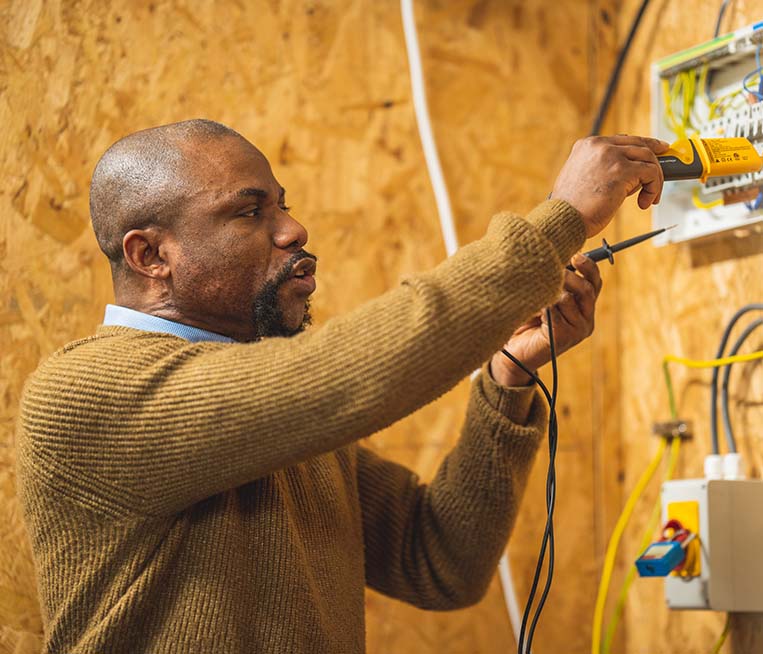
Installing Emergency Lighting Systems
(ATW Certificate Covering the Requirements for Emergency Lighting Systems BS5266)
Course overview
This two day course covers everything you need to know about the installation of emergency lighting including the design and installation of systems, the commissioning and testing, plus the final element of certifying various emergency lighting systems. It will also cover current legislation including the exacting standards required by legal requirements of BS 5266-1, BS 5266-7 & BS5266-8.
The course itself can be taken on its own or can form the ideal complement to our Fire Alarm Systems course. This is because the Fire Alarm Systems course will raise the alarm in the event of a fire, with the emergency lighting highlighting all suitable escape routes that are available making them easy to follow. These systems have for some time now been considered to be an integral part of any commercial buildings and are designed to operate automatically when the primary source of lighting fails. Emergency lighting then remains illuminated for specific period so all inhabitants can evacuate the building.
The overall purpose of this course is to enable candidates to gain the underpinning knowledge and practical skills required to design, install and commission Emergency Lighting Systems.
Who is this qualification for?
This course is designed for anyone including practicing Electrical Installers, Building Maintenance Personnel, Fire Alarm Installers and anyone else who has the desire to learn the hands-on, practical skills to be able to work on Emergency Lighting Systems. Other areas the course will cover includes risk assessment analysis and considerations that need to be made for building layout, allowing for the designation of standard emergency escape routes. Ultimately the course will provide additional skills for fire alarm installers and electrical installers giving them the ability to design emergency lighting schemes.
This course will provides for tutoring on two levels; it will cover the essential elements for new electrical installers and engineers in addition to providing a challenging new skill to learn for most experienced engineers or electrical installers.
Even thought there are no entry requirements to attend this course, we would advise that the course is suitable individuals who have at least some prior knowledge of electrical principles and electrical theory. This is because the course is intensive and uses common electrical terminology and uses practical examples of Emergency Lighting Systems that only candidate with some knowledge will understand. If you are in any doubt as to your suitability then please call.
You will gain the highest standard of achievement
The benefits of attending this course with Access Training are numerous and include the fact that after the course every engineer or candidate will be able to provide their clients with advice on emergency lighting, be able to design a new lighting scheme and be able to install, test and carry out maintenance tasks on emergency lighting. Access Training’s courses ensure that candidates are trained to the high standards required by the building services and Electrical Industries. They help to support and provide a skilled and flexible workforce that gives our students the best preparation for their future career. We offer choice, customer focus and technical expertise in all areas of the construction industry and this course forms part of our specialist range of Electrical qualifications.
Units covered
(Covering the Requirements for Emergence Lighting Systems BS5266)
- Conducting site surveys for design and planning
- How to use test equipment
- Commissioning, certifying and maintaining new systems
- Understanding the regulations and relevant standards for emergency lighting
- Different types of emergency lighting
- Exit signs pictograms, luminance and viewing distances
- How to produce simple designs for high risk areas
- Criteria for lighting of cinemas and theatres
- Procedures for covering particular areas such as stairs
- Choosing maintained or non maintained luminaries
- Glare and colour requirements for the disabled
- Basic installation, wiring and fuse protection
Guided Learning: 2 days
Progress routes
After this course some students also undertake the EAL Part P Domestic Installers qualification and go further with their training. If this is the case than we recommend that completing both as complete package ensuring that the student has practical experience as well as theoretical knowledge of electrical work. This provides students who successfully complete both courses with a good grounding and the ability to carry our domestic installations safely and within the regulations.
Our electrical courses provide a clear progression route, helping learners to achieve the career goals they aspire to. Successful candidates can progress to higher level work during their career and can for example move on to work in the Building Services Industry in roles such as Project Management. This helps those who wish to, to progress from skilled occupations into technical, supervisory or managerial posts. The Level 3 Inspection & Testing also provides candidates with a route to becoming certified to carry out work testing existing electrical installations and gain even more lucrative work in the sector.
- City & Guilds 2382-10: Certificate in 17th Edition of the IEE Wiring Regulations BS 7671:2008 (Level 3)
- City & Guilds 2392-10: Certificate in Fundamental Inspection, Testing and Initial Verification (Level 2)
- City & Guilds 2391-10: Certificate in Inspection, Testing and Certification of Electrical Installations (Level 3)
- City & Guilds 2391-20: Certificate in Design, Erection and Verification of Electrical Installations (Level 3)
Support for students
Access Training is committed to the highest standards of customer focus and technical expertise, with a host of benefits including:
- Specialist, professionally qualified teaching staff with a wealth of industry experience.
- Enhanced Online Assessments, allowing students to sit exams with flexibility to fit around their speed of learning.
- 24hr online support for all student questions and queries when studying away from the training centre.
We train students from anywhere in the UK
The main areas include:
- South Wales
(Cardiff, Swansea, Newport, Bridgend)
- South of England
(Bristol, Gloucester, Bath, Swindon, Oxford, Reading, Slough, London)
- The Midlands
(Birmingham, Hereford, Worcester, Derby, Nottingham, Leicester)
- The South West
(Devon, Cornwall, Exeter, Plymouth, Taunton)
Further information
Information regarding our electrical courses is available from our Course Advice Team. Please call for advice or leave your details and we’ll contact you!