




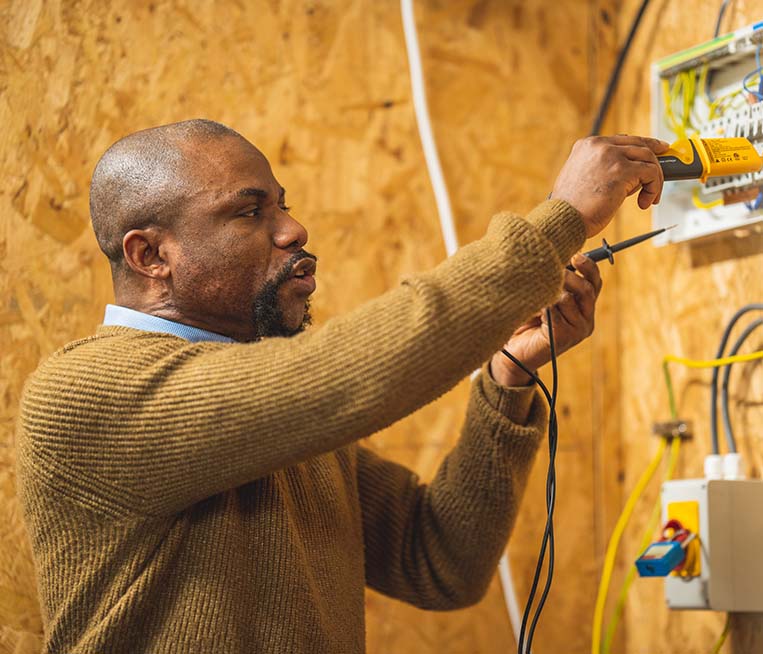
Basic Electrical Theory Course
(ATW Certificate)
Course overview
In our experience, having delivered electrical training courses for many years, it has become apparent that many people who decide to enrol onto particular courses such as our Part P and 17th Edition course, find it difficult to grasp at first and therefore don’t reach the level of understanding they would hope to because they lack the basic electrical installation knowledge. This is why Access Training have developed this bespoke course.
All of the key aspects of electrical installations are covered including the principles behind 1 way and 2 way lighting circuits, radial circuits, ring circuits and cooker/kitchen circuits. This course is designed to introduce delegates to the philosophy of electrical theory, covering key aspects of electrical principles including, an introduction to ohms law, circuits, electrical resistance and electromagnetism, units and symbols, atoms and electrons and current flow and the effects of electrical currents, measurement of voltage, current and power, MCB's and RCD's, how electric motors work, an explanation of transformers and above all electrical safety.
This electrical course will introduce the candidate to the level of understanding required to allow you to work safely and efficiently on electrical equipment and electrical systems. The course delivery is designed to maximise the time the instructors spend with each student with virtually one to one teaching that gives each candidate the instruction and support they need in a ‘step by step’ fashion.
Who is this qualification for?
We have devised this course for the complete beginner as an introduction to electrical principles and electrical theory. It is primarily designed for people with little or no previous experience of electrics but can also be used as by skilled candidates needing a refresher course. In short, the course is designed in the best way possible with regards to teaching delegates the key aspects that relate to the domestic installation of electrical circuits and the theories behind them.
You will gain the highest standard of achievement
All candidates will receive a certificate to confirm their attendance and completion of the course. It is also an option for individuals to sit an examination covering the aspects they have covered on the course, even though this course is non-accredited. This can be provided for delegates as an optional examination that can help those students who intend to progress onto other courses. However, delegates will receive a certificate accredited by Access Training.
Units covered
(ATW Certificate, any of the following aspects can be covered on the course)
- An introduction to electricity and what it is
- What the electrical units are and their relationships to each other
- An introduction to Building Regulations
- What are the electrical safety regulations standards
- A guide to the terminology used in the electrical industry
- A guide to safe isolation procedures
- What is ‘earthing and bonding’ and what are the requirements that are needed
- How to identify components
- What are defined as ‘Special Locations’
- What are the newest and latest circuit requirements
- An introduction to lighting installations
- How to maintain electrical systems
- Electrical supplies and their implications
- How to identify unsafe electrical situations
- How to select cable sizes and components
- How to use test instruments.
- How to read electrical drawings.
- Electrical power theory, including AC supplies, Inductors, Capacitors etc.
- Safe isolation and safe working practices.
Guided Learning: 3 days
Progress routes
After this course some students also undertake the EAL Part P Domestic Installers qualification and go further with their training. If this is the case than we recommend that completing both as complete package ensuring that the student has practical experience as well as theoretical knowledge of electrical work. This provides students who successfully complete both courses with a good grounding and the ability to carry our domestic installations safely and within the regulations.
Our electrical courses provide a clear progression route, helping learners to achieve the career goals they aspire to. Successful candidates can progress to higher level work during their career and can for example move on to work in the Building Services Industry in roles such as Project Management. This helps those who wish to, to progress from skilled occupations into technical, supervisory or managerial posts. The Level 3 Inspection & Testing also provides candidates with a route to becoming certified to carry out work testing existing electrical installations and gain even more lucrative work in the sector.
- City & Guilds 2392-10: Certificate in Fundamental Inspection, Testing and Initial Verification (Level 2)
- City & Guilds 2391-10: Certificate in Inspection, Testing and Certification of Electrical Installations (Level 3)
- City & Guilds 2391-20: Certificate in Design, Erection and Verification of Electrical Installations (Level 3)
Support for students
Access Training is committed to the highest standards of customer focus and technical expertise, with a host of benefits including:
- Specialist, professionally qualified teaching staff with a wealth of industry experience.
- Enhanced Online Assessments, allowing students to sit exams with flexibility to fit around their speed of learning.
- 24hr online support for all student questions and queries when studying away from the training centre.
We train students from anywhere in the UK
The main areas include:
- South Wales
(Cardiff, Swansea, Newport, Bridgend)
- South of England
(Bristol, Gloucester, Bath, Swindon, Oxford, Reading, Slough, London)
- The Midlands
(Birmingham, Hereford, Worcester, Derby, Nottingham, Leicester)
- The South West
(Devon, Cornwall, Exeter, Plymouth, Taunton)
Further information
Information regarding our electrical courses is available from our Course Advice Team. Please call for advice or leave your details and we’ll contact you!