
Are you currently deciding whether university is the right next step for you? With so much media attention around university costs, student loan repayments, and the graduate job market, it’s understandable to feel unsure about whether a degree is still worth your time and money.
While university can be worth the investment if the course you choose gives you the knowledge and qualifications you need to enter your chosen field, it’s one of many routes you can take towards a successful career.
Before you make the choice, it’s important to find out how much money you will likely be borrowing, what specific jobs your course could lead to, and whether you could reach that same career via another path.
How much does university cost in the UK?
University fees and student finance are handled differently across England, Scotland, Wales, and Northern Ireland. The figures below are based on students funded by Student Finance England.
So how much could you borrow towards university costs? For the 2026/27 academic year, eligible full-time students in England can borrow up to £9,790 a year to cover tuition fees. They may also be able to get a Maintenance Loan if needed to help with living costs.
The Department for Education estimates that full-time undergraduate students in England who start in 2025/26 and take out student loans will borrow £45,190 on average over their course.
At face value, that’s a significant amount of debt, but a student loan doesn’t work like a normal personal loan. Under Plan 5, repayments depend entirely on what you earn. For example, in the 2026/27 tax year, you’ll repay 9% of the income you earn above £25,000. These repayments stop if your income falls below that threshold, and any remaining balance is written off 40 years after your student loan repayment period begins.
This means that the amount you borrow is only half the equation. You’ll also need to consider how your repayments will impact the money you actually get to take home once you start working, and factor this into your monthly expenses and other financial commitments.
Do you need a degree for the career you want?
Some careers require a degree, while others can be accessed in different ways. Depending on the job, that could mean an apprenticeship, a vocational course, or training and qualifications gained while working.
Before applying for a university course, check what qualifications employers expect for the jobs you’re interested in. If there’s more than one way into your chosen career, it’s worth comparing:
- How long each route takes
- What each route costs
- The specific qualifications you’ll gain
- Whether you’ll learn mainly through study or practical experience
You don’t need your whole future mapped out before making your next move, but knowing what each route involves and what it can qualify you to do will make the choice much easier.
Does the degree you choose affect whether university is worth it?
Yes it does. The degree you choose to study can influence the jobs available to you and how much you can earn after university.
The latest Department for Education data shows that employment and pay can vary greatly between subjects as early as five years after graduation. For example, earnings were much higher for medicine and dentistry graduates than for performing arts graduates.
The DfE also warns that subject choice is only one part of the picture. Where you live, how much you work, and your previous academic results can also affect what you earn.
But pay shouldn't be your only consideration when choosing a career. It’s also important to understand whether the work suits your strengths and gives you room to progress.
If you’re spending several years on a degree, research the jobs that graduates actually go into and how those careers can develop over time.
When might university not be right for you?
University might not be the right choice for you right now if you’re still unsure what you want to study, or whether you’re ready to commit to several years of a degree. If university feels more like the expected next step than a choice you’ve actually made for yourself, it’s probably a good idea to explore your other options first.
We see this in practice every day. Some of our learners choose trade training instead of university, while others change direction after finishing university or even after years of office-based work. Their experiences show that it’s never too late to rethink which career path is right for you.
The key takeaway is this: choosing an alternative path to university doesn’t mean aiming lower. It means finding the route that best fits what you want from your working life.
What are the alternatives to university?
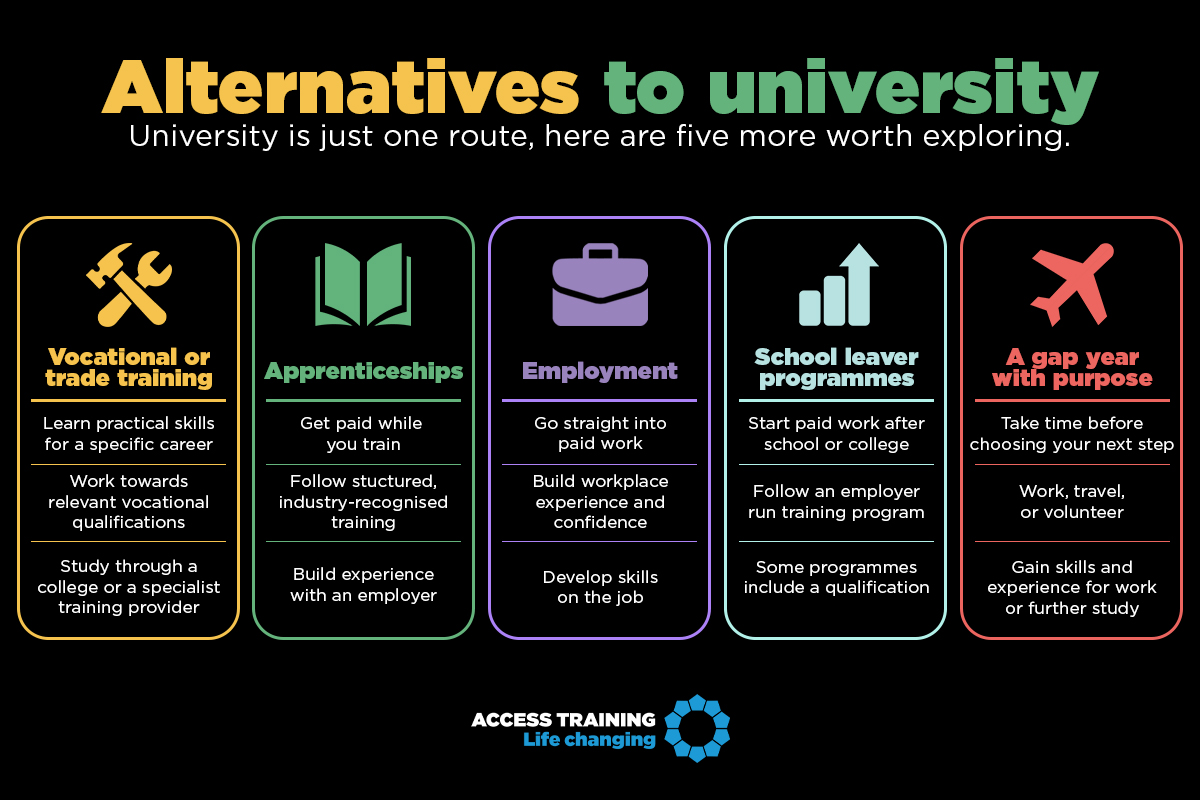
University isn’t your only option after school or college. In the UK, the five main alternatives are apprenticeships, vocational or trade training, school leaver programmes, going straight into work, and taking a gap year.
Each route works differently, so it’s worth understanding what you’ll learn, whether you’ll earn while you train, and what experience or qualifications you could gain.
For a closer look at each of these routes, check out our 5 Alternatives to University guide.
Is learning a trade a good alternative to university?
Yes, it can be! Learning a trade can be a great alternative to university if you know you enjoy practical work and want to see the difference you make to people’s lives every day.
While you won’t need a university degree to enter a career in electrical work, plumbing, or gas engineering, you will need the right training and qualifications - and some routes also require workplace experience or assessments.
Choosing a trade can also give you more control over where your career takes you in the long run. As your experience grows, you can develop specialist skills in areas that interest you, and even work towards starting and running a business of your own.
If a career in the trades sounds appealing, explore our electrician, plumbing, and gas engineer course overviews to see what each trade involves and how we can help you get started.
PAGE UPDATED 16 SEPTEMBER 2026